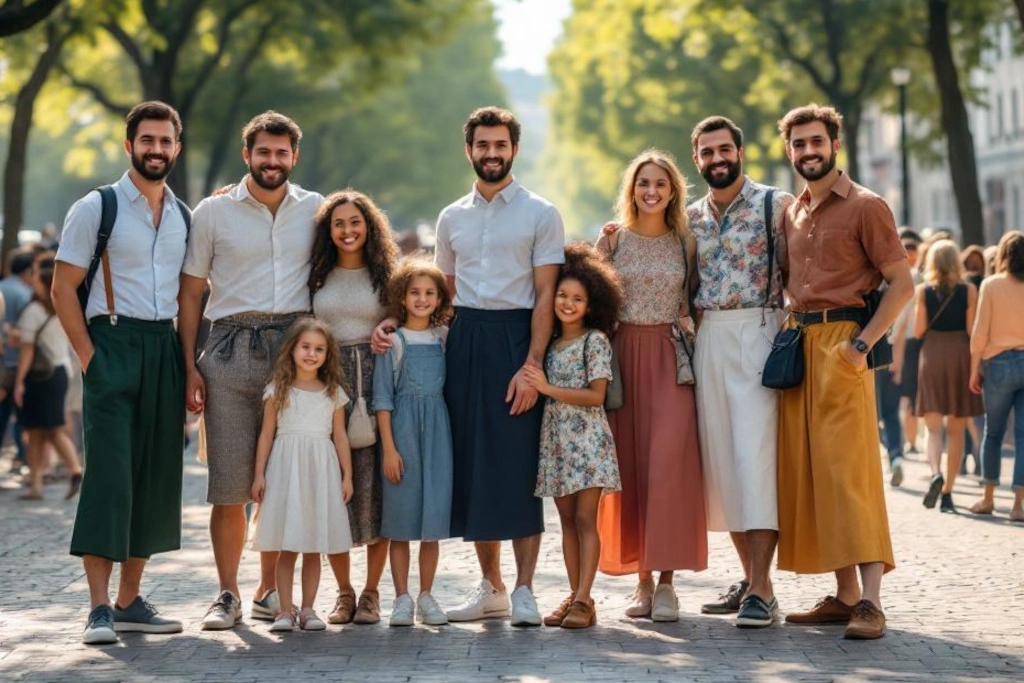
We say it loud and clear: the skirt is unisex. Originally, both men and women wore long skirts; in the Middle Ages, the skirt was a garment worn by both genders. A separation only began in the 15th century, as skirts became increasingly feminine. By the 18th century, men’s skirts had almost entirely disappeared from fashion—but not completely, because the skirt men wear still exists. Think of the Scottish kilt, the sarong worn by Indonesian men, or the uniforms of the Samoan Police Band.
While skirts are often associated with women’s fashion in Western modernity, they are increasingly (re)establishing themselves as gender-neutral clothing. Classic examples include the Scottish kilt, the sarong in Asia, or modern designer skirts for men—all showcasing the diversity of skirts. Slowly but surely, mainstream culture is also beginning to view skirts—and fashion in general—as gender-neutral, where clothing should be functional and stylish rather than defined by binary (male/female) norms. Those who want to learn more about unisex fashion can find out more here.
The Skirt as an Avant-Garde Statement
Skirts are increasingly breaking free from traditional gender norms. Some celebrities are using them to make an avant-garde statement and aim for freer self-expression. As a result, skirts are making a comeback in menswear as well. Well-known designers like Gucci and Burberry are using skirts to redefine masculinity.
The leather skirt in the scene
In the fetish scene, leather skirts for men are a popular and expressive garment, often associated with dominance, rebellion, or a particular aesthetic style.

Overview skirts
- Fustanella: A traditional Greek and Albanian pleated skirt, often made from many white fabric panels (symbolically often 400 pleats).
- Dirndl Skirt (Bavaria/Austria): These skirts are part of traditional Alpine clothing (Tracht) and are often made from linen, cotton, or boiled wool. They come in various lengths (short, midi, maxi) and frequently feature traditional fabric bands or appliqués.
- Kilt (Scotland): The kilt is a traditional Scottish garment that, through its tartan pattern, historically represented the wearer’s social status. Traditionally worn only by men, modern designs now include women’s kilts, including mini-kilts.
- Utility Kilt: A sturdy, modern version of the kilt, often made from cotton or canvas. It features practical details like large side pockets, loops, and metal fastenings.
- Sarong, Dhoti, Lungi: In countries like Myanmar, India, and Fiji, wrap-around skirts or tubular garments are common for both genders. The sarong, often made from lightweight cotton with traditional patterns, is worn as a wrap skirt or beach towel.
- Lehenga/Chaniya: A skirt worn in traditional Indian women’s clothing, paired with a choli (top) and a dupatta (scarf), forming an ensemble called Ghagra Choli.
- Wrap Skirt: A minimalist design that is simply tied around the waist, often featuring asymmetrical lines.
- Kikoi: In East Africa, particularly among the Maasai, the kikoi is a traditional cloth worn by men.
- Culotte Skirt: A wide-cut skirt that visually resembles a skirt but has separate leg openings, offering greater freedom of movement.

Skirt Styles: Different Design Cuts
Primarily, skirt styles are distinguished by their cut, shape, and length.
- A-Line Skirt: This skirt is fitted at the waist and gradually widens toward the hem, resembling the shape of the letter ‘A.’ It flatters most body types.
- Pencil Skirt: A form-fitting, straight skirt that typically ends at or just above/below the knee. It often features a slit or stretch fabric for better mobility and comfort.
- Maxi Skirt: A floor-length skirt that reaches the ankles or nearly to the ground. Maxi skirts are trendy and often exude an elegant look.
- Midi Skirt: The length of this skirt varies but typically ends between the knee and mid-calf. It comes in many different cuts, making it suitable for almost any body shape.
- Mini Skirt: A skirt that ends well above the knee.
- Pleated Skirt: This skirt is characterized by vertical pleats, giving it a structured yet flowing appearance.
- Bell Skirt: This classic style features a narrow waist and a bell-like shape that flares out dramatically toward the hem.
- Wrap Skirt: In this style, the fabric is wrapped around the body and often tied or buttoned at the side. The draping and folds can help conceal problem areas.
- Tulip Skirt: A skirt that resembles an upside-down tulip flower. It is voluminous in the middle and tapered at the edges.
- Balloon Skirt: This skirt creates more volume by folding the hem inward, giving it a “puffed-up” appearance.
Skirt Styles and Their Characteristics
There is a vast selection of skirts, ranging from casual denim and midi skirts to chic leather, pleated, or asymmetrical designs. The chosen skirt should complement the desired silhouette, occasion, and pairing with suitable tops.
- Midi Skirt: The most versatile trend, ending between the knee and calf. Perfect for everyday wear and stylish combinations.
- Maxi Skirt: Often boho in style, with a length that reaches the floor. Ideal for a relaxed yet fashionable look.
- Mini Skirt: A timeless piece for bold outfits that puts the legs in the spotlight. Especially popular in summer.
- Denim Skirt: A durable all-rounder that belongs in every wardrobe—whether in long or short versions.
- Leather Skirt: Adds a cool or elegant touch to any outfit. Often worn as a pencil skirt.
- Pleated Skirt: Playful and romantic at the same time, with delicate pleats that add dynamism to the look.
- A-Line Skirt: Fitted at the top and flared at the bottom. A flattering cut for almost any body shape.
- Asymmetrical Skirt: An eye-catching style, often adorned with ruffles or unique hems.
- Wrap Skirt: Features a unisex fit and is often seen in summer.
Fit of skirts
The ideal fit for skirts varies depending on individual body shape, but ideally, the waistband should be positioned at the narrowest point of the waist. A-line skirts flatter almost every figure, while knee-length pencil skirts accentuate curves. A 4-5 cm allowance at the hips, slightly more for curvy figures, ensures a comfortable fit.
Fit depending on body type:
- A-shape (wide hips, narrow shoulders): Skirts with a slight flare that flatter the hips.
- H-shape (athletic/straight): Flared skirts create curves.
- V-shape (broad shoulders, narrow hips): Flared skirts with embellishments (pleats).
- O-shape (round waist): Straight, loose skirts with soft lines.
- X-shape (hourglass): Dresses that accentuate a narrow waist.
The ideal skirt length is where the leg narrows (usually just above or below the knee).
Modifications & Convenience:
- The skirt should not feel restrictive when walking or sitting.
- If the waistband is too tight or too loose, the buttons can be adjusted.
- For materials that don’t stretch (such as linen or cotton), it’s best to choose one size larger.
Design Cuts
- A-line: Accentuates the waist, conceals the stomach and thighs.
- Pencil skirt: Fitted, highlights curves, often with a slit for greater freedom of movement.
- Wrap skirt: Conceals problem areas around the stomach and hips.
- Maxi skirt: Reaches the floor, perfect for a flowing look.